Applied research · Innovation and emergence

“A laboratory that manufactures only one thing: emergence.”

Research · Computational creativity

Emergence Lab is an applied research lab in computational creativity — the scientific field that studies how machines can produce, and help people produce, ideas that are new, surprising and valuable. Its working hypothesis is that emergence — the appearance of something none of its parts contained — is not an accident but a process that can be studied, provoked and traced. The lab turns that research into innovation: research platforms such as Collider Lab, where six platforms make new ideas emerge from collisions between distant concepts, and Creativity Foundry, an ideation platform that combines several ways of producing ideas.

See the platforms 

Projects · Applied AI

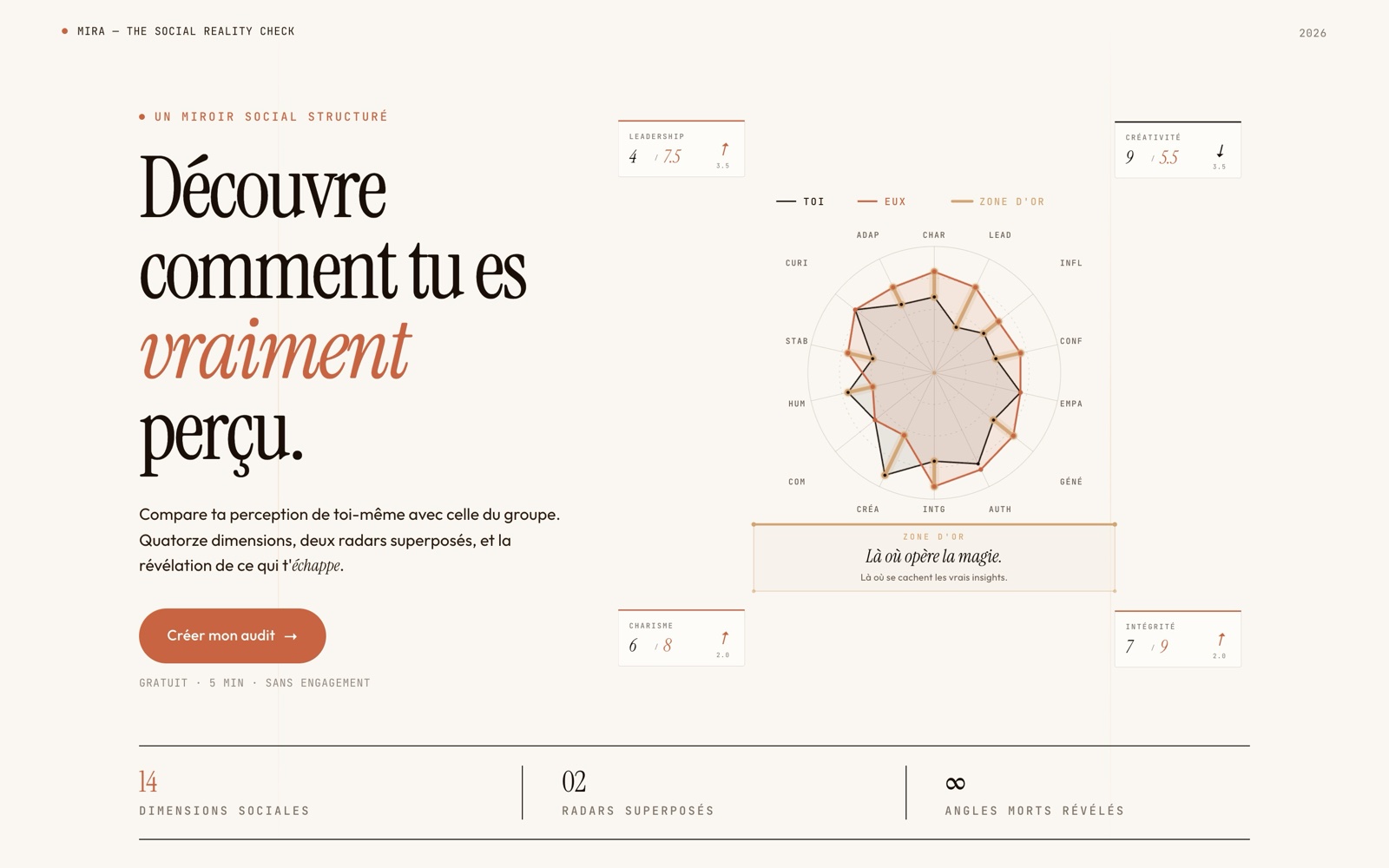
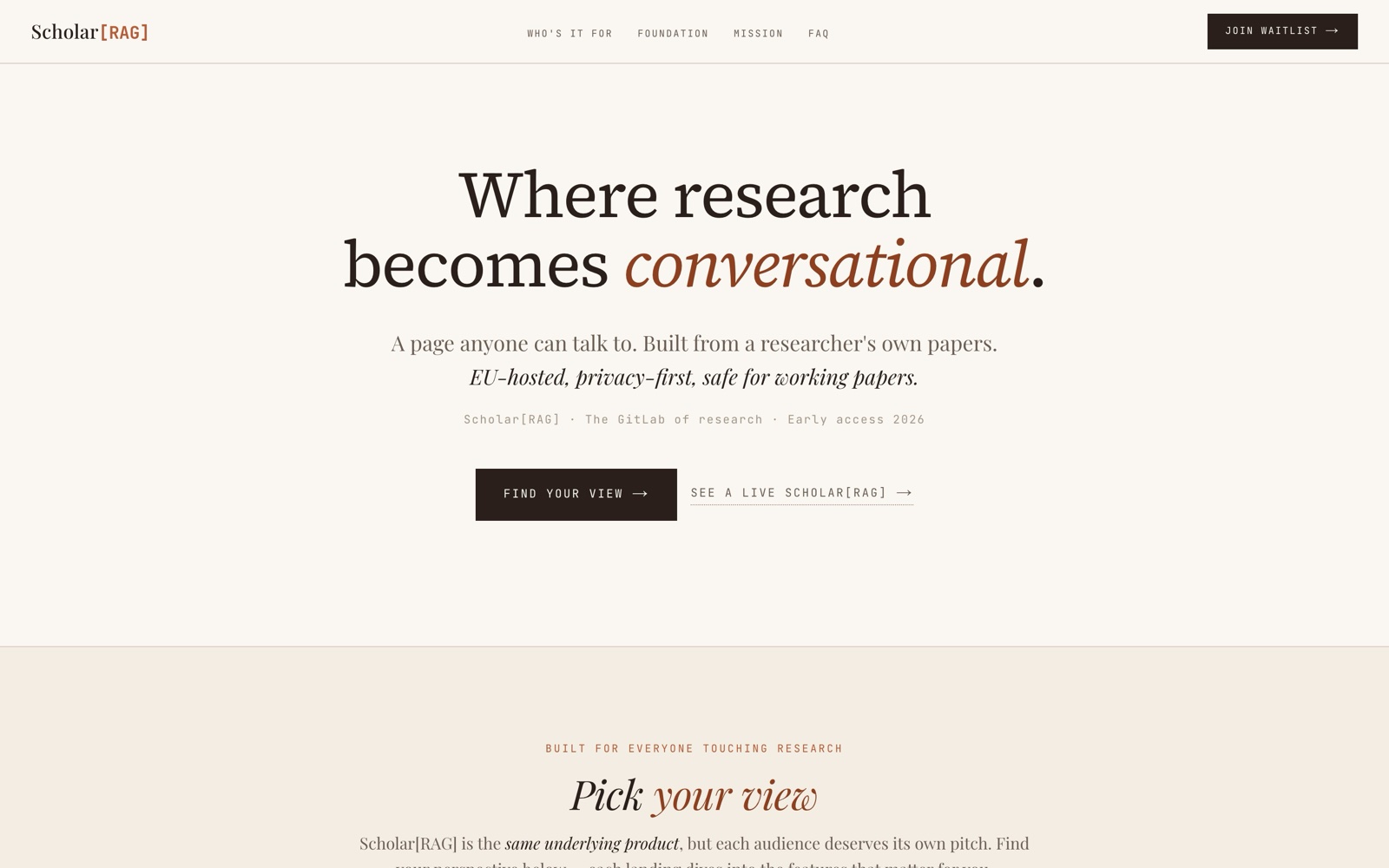
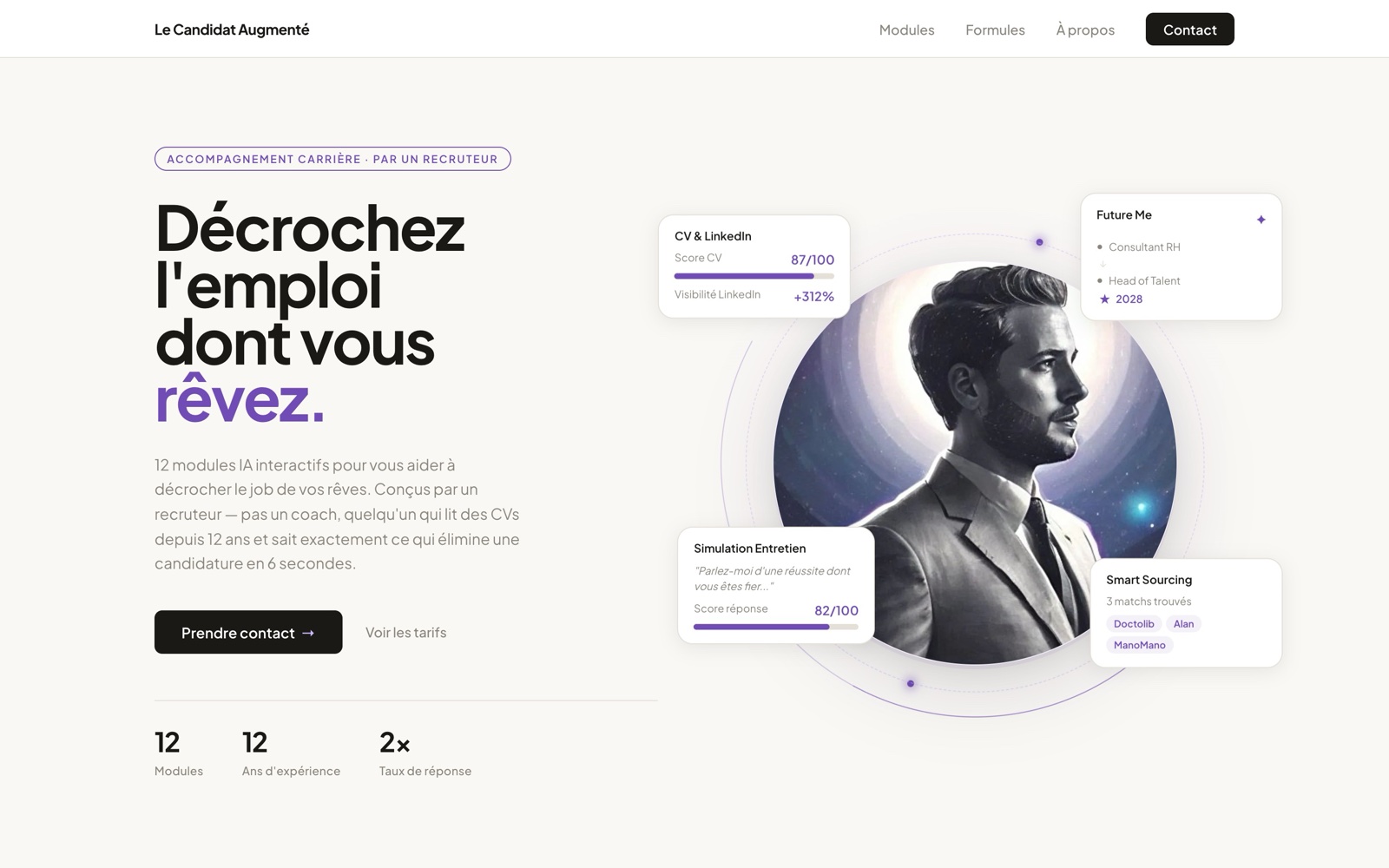
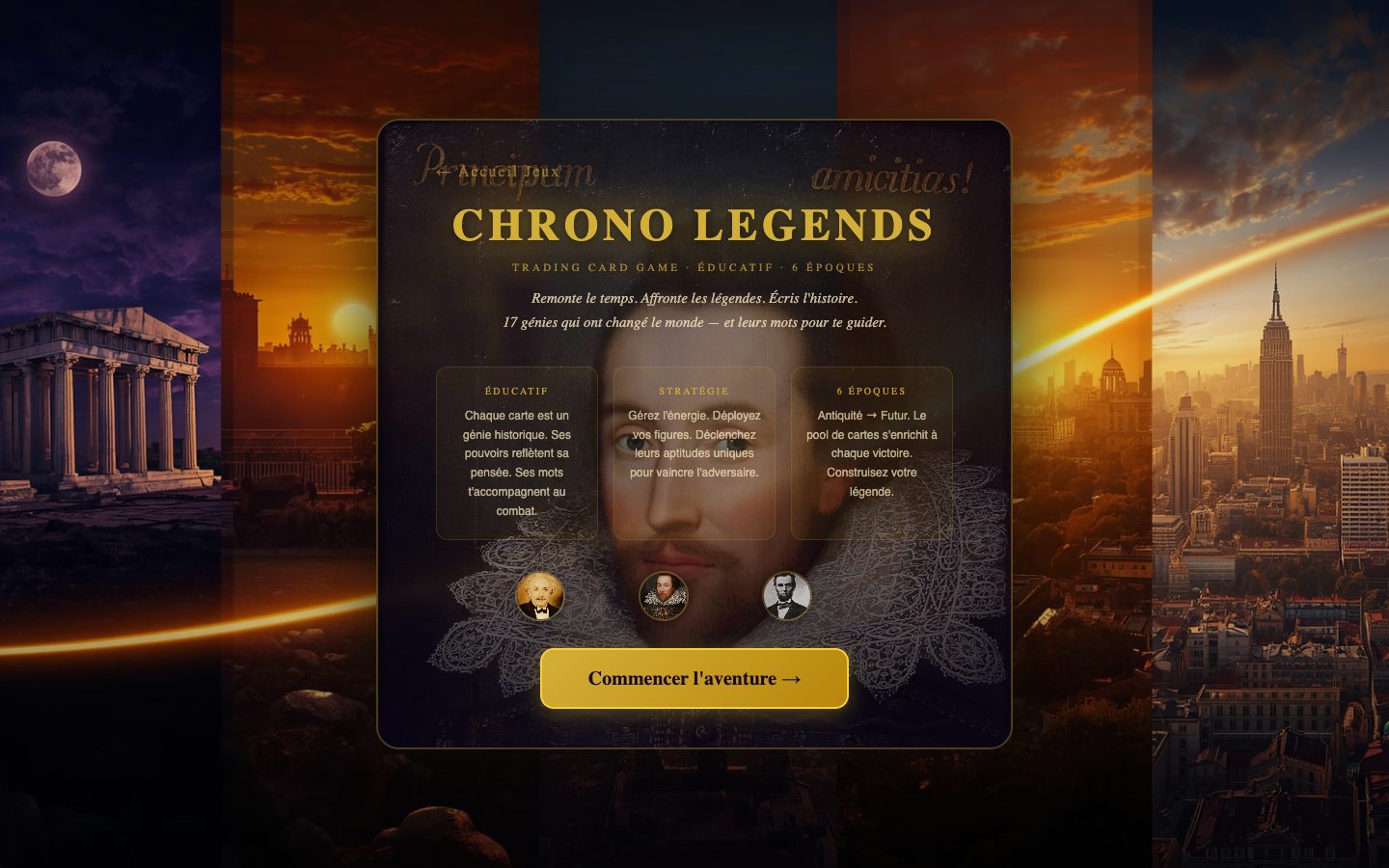
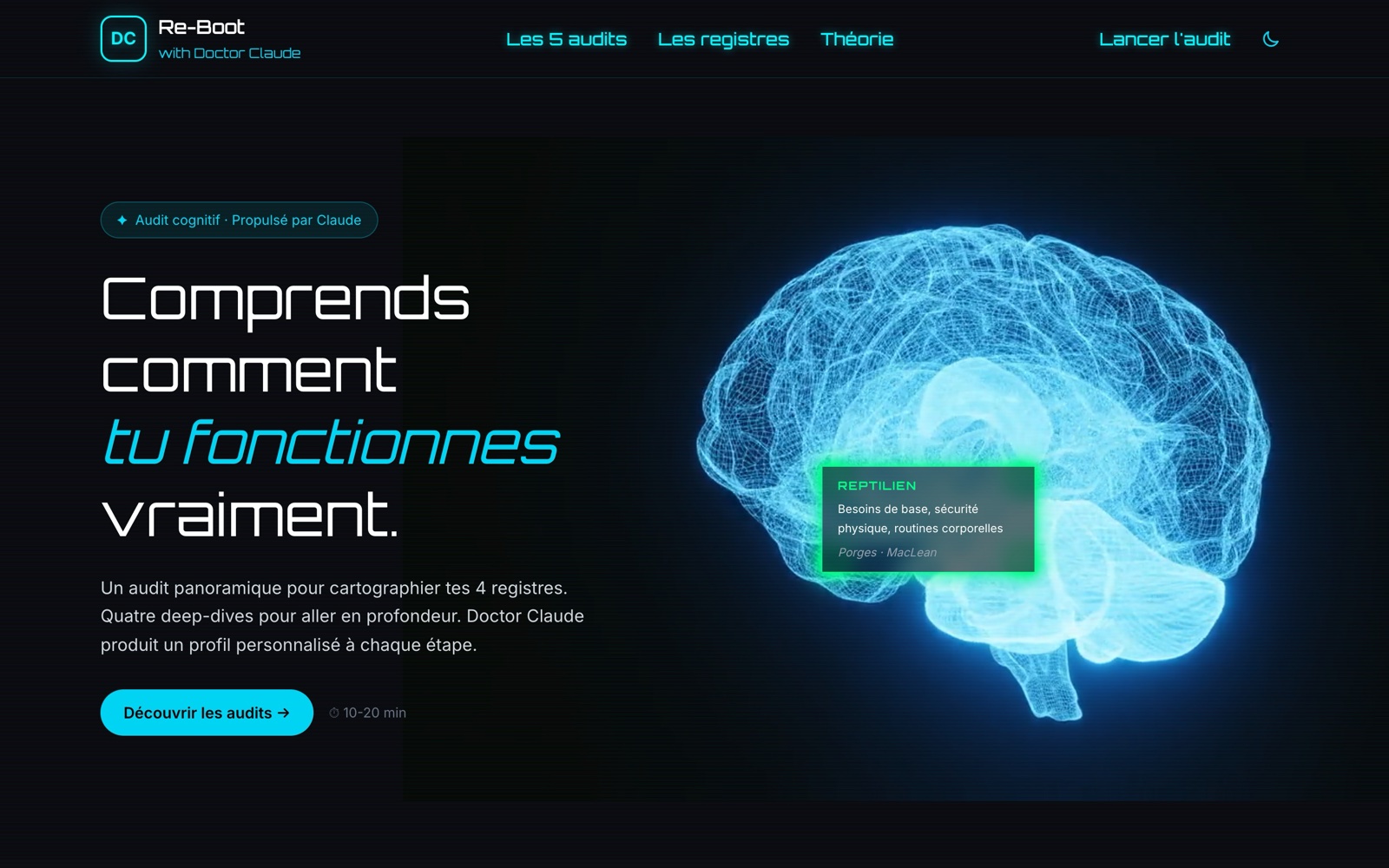
Alongside its platforms, the lab develops projects and applications that put AI to a precise use in specific fields: mapping how you think (Re-Boot) and seeing yourself as others see you (Mira) in psychology, turning a researcher’s own papers into a conversation (ScholarRAG), charting a career path (Career Path), and exploring the lives of great historical figures through play (Play with History). Each one is built with AI as a partner, not a substitute for human judgement, and each result is published with its limits. All of them are working prototypes, still being evaluated.

See the projects 

I·Platforms

Platforms for research.

Platforms are research programmes that test a method in the open.

Key Liveavailable Prototypeworking, being evaluated Researchunder development

I.1 · Collider LabPrivate preview

Collider Lab

Augmenting human creativity, one collision at a time.

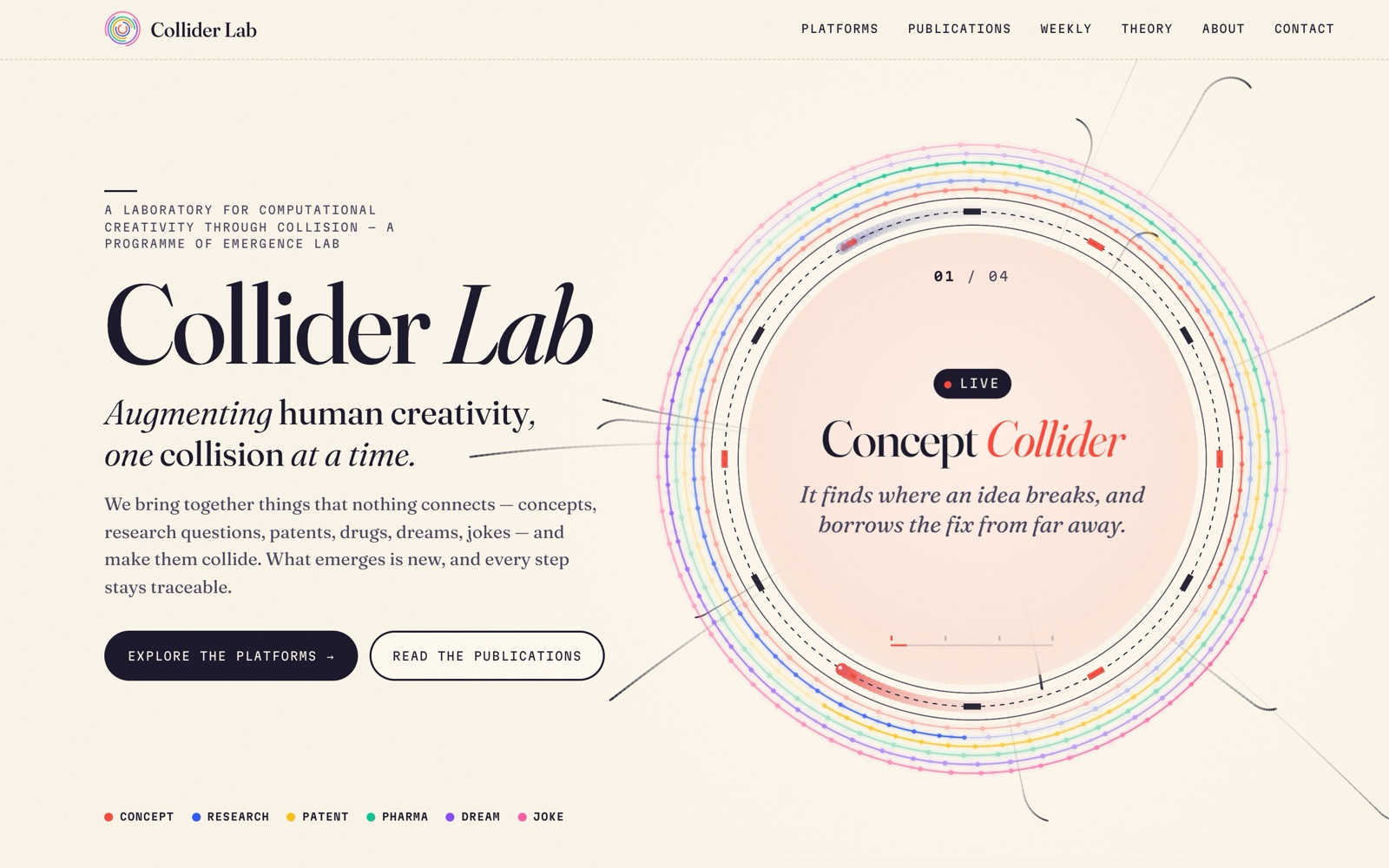
Collider Lab is the lab’s research programme in computational creativity, the study of how machines can help produce new ideas. Its method is collision: bring together two things that nothing connects, make them collide, then select among what emerges. Six platforms apply it to concepts, research questions, patents, drugs, dreams and jokes. So far, the evidence shows that collisions move AI-generated ideas away from the usual answers and repeat earlier ideas far less often. It does not yet show that this amounts to creativity. That question is still under test.

The machine steers, the human selects. Every step stays traceable.
Demo upon request Platform page : Collider Lab

Collider Lab home page: the accelerator ring around the Concept Collider
Fig. 1Collider Lab: the accelerator ring

C/01 — C/06 · Six platforms

  1. C/01Live

    Concept Collider

    It finds where an idea breaks, and borrows the fix from far away.

  2. C/02Live

    Research Collider

    It aims a collision at a research question, then tests the answer on real data.

  3. C/03Prototype

    Patent Collider

    It moves a patent’s mechanism to a new field — without dropping its specifications.

  4. C/04Prototype

    Pharma Collider

    It finds new uses for existing drugs — and keeps only the leads that survive four gates.

  5. C/05Research

    Dream Collider

    It runs the Collider backwards: from a dream to the tension behind it.

  6. C/06Research

    Joke Box

    It tests whether humour follows rules a machine can measure.
I.2 · Creativity Foundry

Creativity Foundry

An ideation platform that combines several ways of producing ideas, collision being one of them.

Coming soon

II·Projects

Projects for people.

Projects take what the lab learns and turn it into tools people can use.

III·Publications

The lab’s published work: papers on its methods, surveys of the field, and essays. Each one is available with a DOI or in conference proceedings. One has been through peer review: the short paper accepted at ICCC 2026, the International Conference on Computational Creativity. The others are preprints, open to reading and discussion.

  1. P/01ICCC 2026Peer-reviewed

    Introducing the Concept Collider: A White-Box Computational Framework for Targeted Creative Emergence

    The founding paper, peer-reviewed at ICCC 2026: a framework that produces ideas on purpose and keeps a trace of how each one emerged.

    PDF (opens in a new tab)
  2. P/03Zenodo preprint

    Introducing the Research Collider: Goal-Conditioned Concept Collision for Grounded, Falsifiable Research Directions

    The method aimed at a research question: it proposes a direction, turns it into a model that can be run, and checks it against the literature. Its leads are not guaranteed true, but they are traceable and testable.

    DOI 10.5281/zenodo.21445492 (opens in a new tab)
  3. P/10Zenodo preprint

    AI: Superpower or Superweakness? — Output, Competence, and the Human Faculties That Decide

    An essay on when AI makes people more capable and when it makes them less so, and on the human faculties that should stay human: intention, judgement, taste and responsibility.

    DOI 10.5281/zenodo.21450601 (opens in a new tab)

IV·Services

The lab as your partner.

Two ways to work with the lab, depending on where your project stands: before you commit to an idea, or once you have a working product.

IV.1 · Idea phase

EmergenceLab Incubator

“We map where your idea can go — before you have to choose.”

Grounded in computational creativity research, our proprietary method analyzes your concept across two dimensions: conceptual distance (how far your idea departs from existing solutions) and emergence potential (the likelihood that a combination generates something structurally new). Where conventional tools generate ideas at random, we map the zones of structural tension where emergence is predictable — and surface development paths your linear reasoning wouldn’t have reached.

What you receive

  1. 01Emergence Map of your concept — positioning in the conceptual space
  2. 025 alternative paths scored by emergence potential and conceptual distance
  3. 03Strategic recommendation based on your current stage
  4. 0460-minute debrief session

Foridea holders at definition or market validation stage — before committing resources to a single direction.

Apply

IV.2 · Validated MVP

EmergenceLab Accelerator

“Your stack as a starting point. The technical possibility space as terrain.”

Our AI-augmented technical analysis pipeline examines your codebase, extracts dominant patterns, maps the accessible technical possibility space, and generates development specifications structurally coherent with your existing architecture. We measure the distance between your architecture and the field of possibilities — and formalize those opportunities into implementation-ready specifications.

What you receive

  1. 01Architecture analysis report (dominant patterns, strengths, friction zones)
  2. 02Selection of complementary technical approaches and components
  3. 032–3 feature spec sheets, prioritized by impact × feasibility
  4. 04Technical implementation roadmap

Forearly-stage startups with a validated MVP — in lieu of a technical innovation consultant.

Apply

V·Manifesto

“AI is a partner, not a tool. The lab’s projects are not ‘AI-assisted’: they are co-designed with AI.”

P/01 — P/03 · Three principles

  1. P/01

    AI is a partner, not a tool.

    Each project is built with AI as a partner, not a substitute for human judgement.

  2. P/02

    Emergence is not an accident.

    It is a process that can be studied, provoked and traced.

  3. P/03

    Research and practice feed each other.

    Papers give the tools their legitimacy; real results enrich the hypotheses.

Portrait of Sebastian Wahl (illustration)

Sebastian Wahl

Sebastian Wahl founded and directs Emergence Lab. Trained in business, computer science and nanotechnology, he carried out doctoral research in microfluidics (three papers, one patent) and co-founded a start-up in water technology. Passionate about AI and the opportunities it offers, he now focuses his research on computational creativity: he is the author of Collider Lab’s founding paper, accepted at ICCC 2026.

About the Lab

Emergence Lab is an independent applied research lab, published by IMPACT SAS (Paris). Its research is published openly — on Zenodo with a DOI and at the International Conference on Computational Creativity — and its platforms and projects are built in close dialogue with AI.

VI·Contact

Let’s make something emerge.

For a project, a collaboration, a research question or a press request, write directly.